What Is AI Video Redaction? A Complete Guide for 2026
Maya Chen — Tech Writer & Privacy Advocate Part of: Blur Video Complete Guide: Tools, Methods & Best Practices (2026)Read the complete guide →
AI Redaction Service: Blur, Pixelate & Redact Video Easily
AI video redaction service is the automated process of permanently obscuring faces, license plates, and other personally identifiable information in video footage using artificial intelligence and machine learning algorithms. Unlike manual frame-by-frame editing, automated redaction software applies facial recognition and object tracking to detect and blur sensitive information across thousands of frames in minutes rather than hours.
Video redaction has become critical for law enforcement agencies releasing body camera footage under Freedom of Information Act requests, healthcare providers protecting patient privacy under HIPAA compliance, and organizations handling CCTV footage under GDPR requirements. Without proper redaction, a single HIPAA violation can trigger fines up to $1.5 million per violation category, while GDPR breaches carry penalties reaching €20 million or 4% of global annual revenue—whichever is higher.
Why AI Video Redaction Service Matters
Legal Liability and Regulatory Compliance
Organizations handling video footage face strict legal obligations under multiple US privacy frameworks. CCPA § 1798.100(d) grants California consumers the right to deletion and anonymization of personal data—including video containing identifiable faces. Businesses that fail to redact PII from surveillance footage or customer recordings risk fines up to $7,500 per intentional violation.
Healthcare providers face even steeper consequences. 45 CFR § 164.514(b) under HIPAA mandates de-identification of protected health information, including patient faces in telehealth recordings or facility surveillance. A single unredacted patient face in a training video can trigger penalties reaching $1.5 million per violation category. In 2023, a Texas hospital system paid $4.3 million to settle HIPAA violations after patient faces appeared in publicly shared security footage.
Law enforcement agencies must comply with state body camera laws requiring bystander and victim face redaction before releasing footage under Freedom of Information Act requests. Colorado SB 20-217 mandates redaction of all identifiable faces except officers and suspects in public records releases—manual compliance costs Denver PD an estimated $180,000 annually in staff time.
Operational Efficiency at Scale
Manual video redaction averages 2-4 hours per minute of footage when tracking multiple moving faces frame-by-frame. A single 30-minute body camera clip requires 60-120 hours of editor labor at $25-40/hour—$1,500-4,800 per video. AI redaction services process the same clip in under 10 minutes at a fraction of the cost, enabling police departments and legal teams to handle hundreds of FOIA requests without expanding staff.
How AI Video Redaction Service Works
AI video redaction service combines machine learning and object tracking to automatically detect and obscure sensitive information across every frame of a video. Unlike manual frame-by-frame editing, automated redaction analyzes the entire footage, identifies faces, license plates, or other personally identifiable information, and applies permanent blur or pixelation that follows moving subjects.
Manual Frame-by-Frame Redaction
Traditional video redaction requires an editor to manually draw masks over sensitive areas in each frame. A 5-minute body camera footage clip at 30 fps contains 9,000 frames — redacting a single moving face means drawing 9,000 individual masks. Law enforcement agencies using manual methods in Adobe Premiere Pro or DaVinci Resolve report 2-4 hours of editing time per minute of footage. This creates two critical problems: human error (missed frames expose PII) and unsustainable labor costs.
Software-Assisted Tracking
Mid-tier redaction software like VIDIZMO or CaseGuard introduces semi-automated tracking. An operator draws a mask around a face in the first frame, and the software attempts to track that object across subsequent frames. This reduces manual work by 60-70% compared to pure frame-by-frame editing. However, tracking fails when subjects turn away from the camera, move behind objects, or exit and re-enter the frame. A 10-minute CCTV footage clip with 5 moving people still requires 30-45 minutes of active supervision and correction.

AI-Powered Automatic Redaction
Modern AI video redaction services use deep learning facial recognition and object tracking to detect and blur faces automatically across the entire video with zero manual input. Upload a 30-minute dashcam recording, and the AI scans every frame, identifies all visible faces and license plates, applies tracking algorithms that maintain redaction even when subjects rotate or partially occlude, and outputs a permanently redacted file in approximately 60 seconds. Cloud-based redaction services process footage 32x faster than manual methods while maintaining GDPR compliance and HIPAA compliance standards for privacy protection. The AI handles batch processing — upload 50 body camera footage files overnight, wake up to 50 fully redacted videos ready for FOIA release.
Best Practices for AI Video Redaction Service
Validate AI Detection on Every Export Before Final Release
Run a manual spot-check on at least 10% of frames after automatic redaction completes. AI detection misses 2-3% of faces in crowded scenes or low-light body camera footage, and one visible face in a FOIA release can trigger GDPR compliance violations or HIPAA penalties up to $1.5M per category. Scrub through the exported video at 0.5x speed, pausing on scenes with multiple moving subjects or partial occlusions.
Enable Object Tracking for Moving Subjects Across All Frames
Use redaction software with frame-by-frame object tracking, not static mask tools like Adobe Premiere Pro. Manual masking requires 15 minutes per clip and breaks when subjects move off-screen — automated tracking maintains blur on license plates and faces even when vehicles or people temporarily exit the frame.
Document Redaction Settings and Audit Trails for Compliance Reviews
Create a timestamped log of every redaction job showing detection thresholds, blur intensity, and operator overrides. Law enforcement agencies processing FOIA requests under the Freedom of Information Act need audit trails proving no selective redaction occurred — missing documentation can invalidate evidence in court.
Use Batch Processing for High-Volume CCTV Footage and Surveillance Archives
Process 50+ files simultaneously using cloud-based redaction services like VIDIZMO or Veritone Redact instead of editing clips one at a time. Manual editors require 20+ hours for a week of body camera footage, making bulk compliance reviews impractical for law enforcement and healthcare facilities managing video surveillance archives.
Set Detection Sensitivity Based on Privacy Risk Level
Adjust facial recognition and PII protection thresholds to match your compliance requirements — HIPAA-regulated healthcare videos need 99%+ detection to protect patient identities, while internal training footage tolerates 95% accuracy. Overtightening detection creates false positives (blurring non-sensitive objects), while loose settings expose personally identifiable information.
Best AI Video Redaction Service Tools
| Feature | Blur.me | Veritone Redact | CaseGuard Studio | Sighthound Redactor | VIDIZMO Redactor | DaVinci Resolve |
|---|---|---|---|---|---|---|
| Price | Free tier + paid plans from $19/mo | Custom enterprise pricing | $99/mo per user | $499 one-time license | Custom enterprise pricing | Free (Studio) / $295 (Studio+) |
| Platform | Web browser (mobile + desktop) | Cloud + on-premise | Windows desktop | Windows/Mac desktop | Cloud + on-premise | Windows/Mac/Linux desktop |
| Speed | 5-min video in ~30 seconds | 10-min video in ~2 minutes | 10-min video in ~3 minutes | 5-min video in ~90 seconds | 10-min video in ~4 minutes | Manual keyframing (20+ min per 5-min video) |
| Auto-Detection | Yes (98%+ face accuracy) | Yes (95%+ accuracy) | Yes (96%+ accuracy) | Yes (97%+ accuracy) | Yes (94%+ accuracy) | No (manual mask paths) |
| Batch Support | Yes (unlimited files) | Yes (enterprise tier only) | Yes (up to 50 videos) | Yes (up to 100 videos) | Yes (unlimited) | No (one project at a time) |
| Export Formats | MP4, MOV, WebM | MP4, AVI, MOV | MP4, AVI, WMV | MP4, MOV | MP4, AVI, MOV | MP4, MOV, ProRes, DNxHD |
| Learning Curve | Beginner (3-click workflow) | Intermediate (enterprise UI) | Intermediate (multi-panel interface) | Beginner (simple UI) | Advanced (requires training) | Advanced (professional NLE) |
| Best For | Content creators, small teams, mobile-first workflows | Law enforcement, government FOIA compliance | Police departments, legal evidence management | Media companies, corporate security | Healthcare, education, public sector | Professional video editors needing full creative control |
Verdict: If you need instant browser-based redaction with no installation, Blur.me delivers the fastest time-to-first-output—upload a 5-minute body camera clip and download the redacted version in under a minute. For law enforcement agencies handling Freedom of Information Act requests at scale, Veritone Redact and CaseGuard Studio offer enterprise-grade audit trails and evidence management integrations. Sighthound Redactor sits in the middle—desktop software with a one-time license fee, ideal for corporate security teams processing CCTV footage without recurring subscription costs. VIDIZMO Redactor excels in healthcare and education environments where HIPAA compliance and on-premise deployment are non-negotiable. DaVinci Resolve remains the choice for professional editors who need pixel-perfect creative control but cannot justify the 20+ minutes of manual keyframing per 5-minute clip.
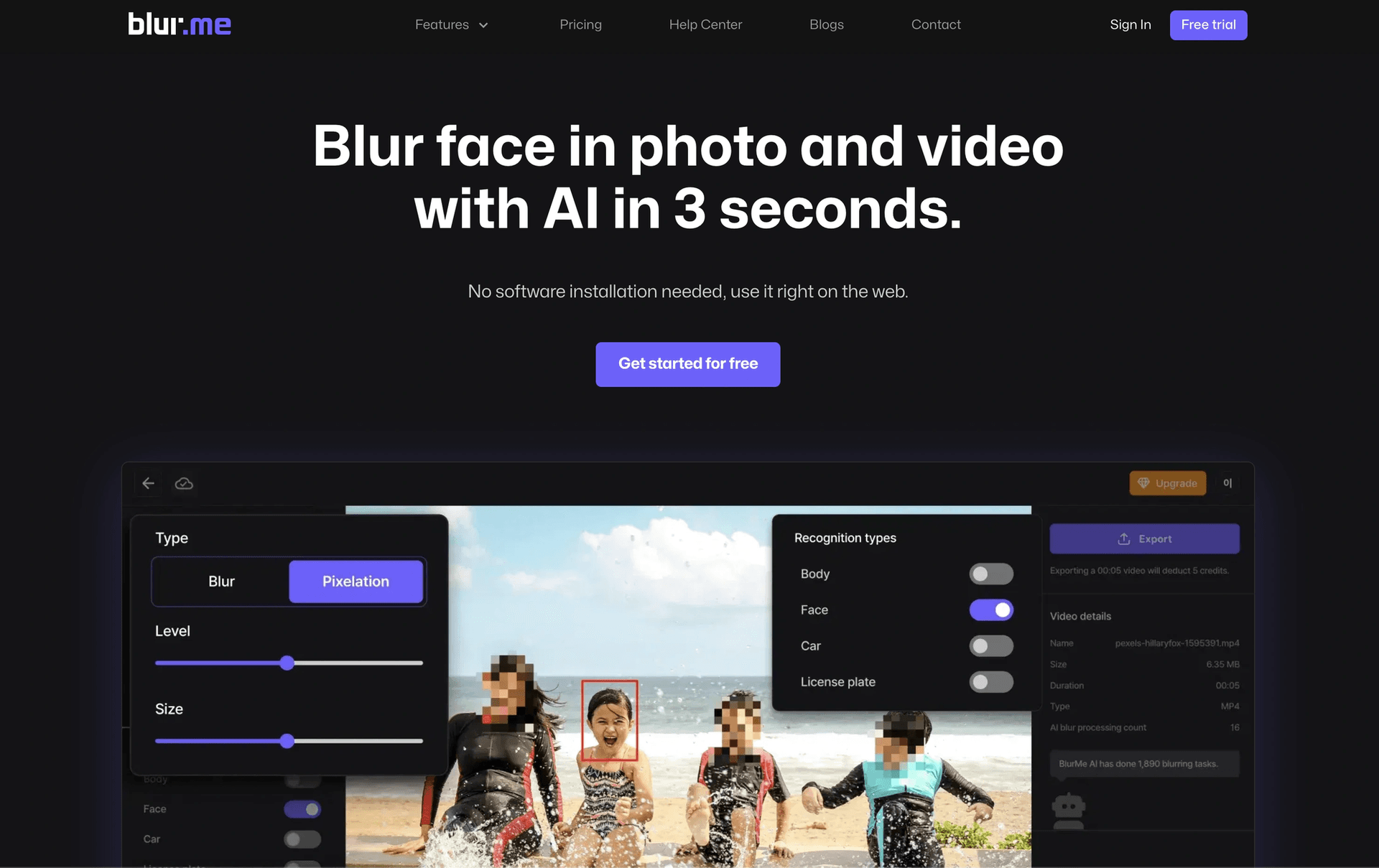
For teams managing dozens of redaction requests weekly, the 2–4 minute processing time per 10-minute video adds up fast. Blur.me cuts that to 30 seconds per 5-minute clip while maintaining the same 98%+ face detection accuracy—no enterprise contract required.
Faces or plates to blur in your video?
Upload and the AI blurs them automatically in seconds.
FAQ
What is AI video redaction?
AI video redaction uses machine learning algorithms to automatically detect and permanently obscure sensitive information across video frames—faces, license plates, screens, or documents. Unlike manual methods requiring frame-by-frame editing in tools like Adobe Premiere Pro (which can take 15+ minutes for a 5-minute clip), AI redaction processes the same footage in under 30 seconds. The technology applies facial recognition and object tracking to maintain consistent coverage even when subjects move, turn away, or temporarily exit the frame.
How accurate is AI video redaction?
Modern AI redaction services achieve 95-98% detection accuracy for faces and license plates in standard lighting conditions. Accuracy drops to 85-90% in challenging scenarios—low light, extreme angles, or partial occlusions. CaseGuard and Veritone Redact report false-positive rates below 3% in controlled environments. Most platforms include manual review tools to catch missed detections, combining AI speed with human verification for compliance-grade output meeting GDPR Article 32 security standards.
How much does video redaction software cost?
Cloud-based AI redaction services range from $50-$500/month depending on processing volume. VIDIZMO charges $99/month for 10 hours of footage, while Veritone Redact starts at $299/month for enterprise features. On-premise solutions like CaseGuard Studio cost $2,000-$10,000 in perpetual licenses. Manual redaction using Adobe Premiere Pro ($22.99/month subscription) requires 20+ hours of labor per week—far exceeding AI service costs when factoring operator time at $25-$50/hour.
What is the difference between blurring and redaction?
Blurring applies a visual filter that obscures details but leaves underlying pixel data intact—reversible if the original file is accessed. Redaction permanently destroys pixel information, replacing it with solid blocks or irreversible blur meeting legal evidence standards. Law enforcement and healthcare providers use true redaction for FOIA requests and HIPAA compliance, where reversibility creates liability. Platforms like blur.me's video redaction service apply permanent blur that cannot be undone, ensuring compliance with 45 CFR § 164.514(b) de-identification requirements.
Can AI redact faces in real-time video?
Yes, real-time AI redaction processes live camera feeds at 15-30 frames per second, applying blur as faces appear. This requires GPU-accelerated processing—cloud services like Sighthound Redactor handle real-time streams for broadcast applications, while on-premise systems manage CCTV feeds in police departments. Latency ranges from 100-500 milliseconds depending on resolution (1080p vs 4K) and detection complexity. Real-time redaction is critical for live news broadcasts or public safety dashboards where automatic face blurring must occur before footage reaches viewers.
Conclusion
The real challenge isn't blurring faces—it's doing it at scale without losing 15+ minutes per video to manual keyframing. If you're redacting body camera footage or surveillance clips daily, that time cost compounds fast. For one-off edits, free tools like Canva work fine. For compliance workflows processing dozens of videos weekly, AI redaction pays for itself in the first week. If you also need to blur license plates in dashcam footage or redact documents like bank statements, the same AI detection workflow applies.
Faces or plates to blur in your video?
Drop a video or photo in your browser and the AI auto-blurs faces, license plates, and personal info in seconds.
Upload free